Who this checklist is for?
This checklist is for personal trainers, group fitness instructors and strength coaches who invoice gyms, studios or clients directly under their own ABN.
As a sole trader, your business expenses are claimed in your individual tax return through the Business and Professional Items schedule, not as employee work-related expenses.
Work through each section, tick the items that apply to you, and bring this list along with your records to your appointment. It covers the 2025–26 income year (returns now being prepared) and the 2026–27 year that started on 1 July 2026.
Before you claim
Three rules apply to every expense on this list:
1. You spent the money yourself and were not reimbursed by the gym, studio or client.
2. The expense relates directly to earning your training income.
3. You have a record (tax invoice, receipt, bank statement or logbook) to prove it.
If an item is used for both business and private purposes, only the business-use portion is
deductible.
Personal services income (PSI). Most personal training income is a reward for your own skill and effort, so it is PSI.
If the PSI rules apply to you, some deductions are restricted, including rent, mortgage interest and rates for a home gym or home office, and payments to an associate such as a spouse.
The PSI rules do not apply if you pass the results test for at least 75% of your PSI, or if less than 80% of your PSI comes from one client and you pass one of the other personal services business tests.
A trainer who works mainly for one gym is often caught by the 80% rule, so tell us how your income is split between gyms and private clients.
[ ] I know roughly what percentage of my income came from my largest gym or client.
[ ] I have copies of my contractor agreements with each gym or studio.
GST. You must register for GST once your turnover reaches $75,000 a year. If you are registered, claim expenses net of the GST credits already claimed on your BAS.
[ ] I am registered for GST (if yes, bring your lodged BAS statements)
Hobby vs business. A side income from a few sessions a month for friends may not be a business. Regular, advertised, commercially run training usually is. If you are unsure, ask us before claiming a loss.
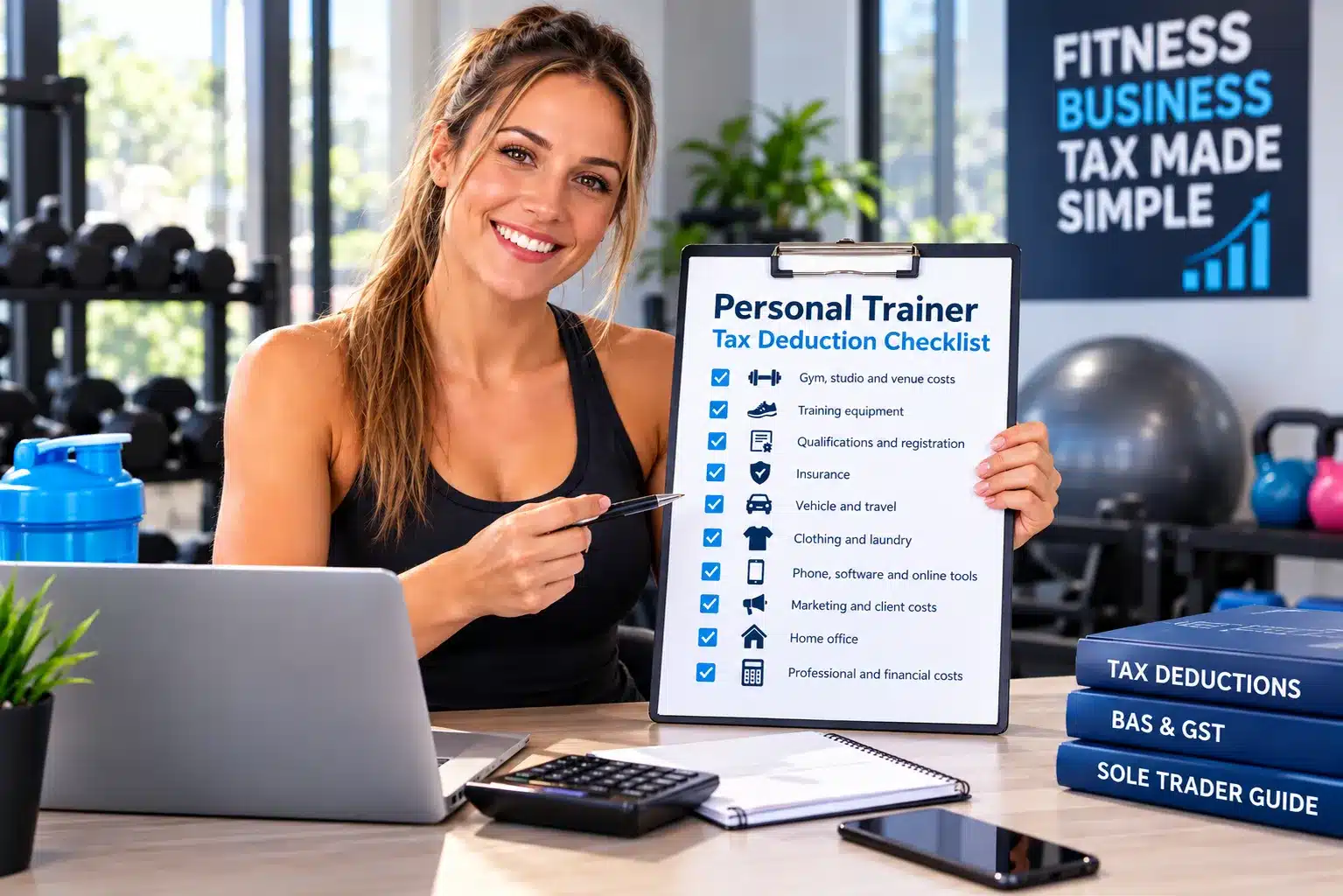
Deduction checklist
Gym, studio and venue costs
– Rent or floor fees paid to a gym or studio to train your own clients
– Hourly studio or room hire
– Council permits for outdoor training in parks and reserves
– Music licence fees for group classes you run yourself
Training equipment
– Dumbbells, kettlebells, barbells, plates and racks
– Resistance bands, mats, foam rollers, boxing gloves and pads
– Heart rate monitors, timers, portable speakers and body composition scales
– Repairs, servicing and replacement of equipment
– Storage or trailer hire for equipment
Assets costing less than $20,000 each can generally be written off in full in the year you first use them. Higher-cost assets are depreciated through the small business pool.
Qualifications, registration and insurance
– Short courses, workshops and CEC/CPD points that maintain or improve your current skills
– Specialist add-on certifications (for example, pre and post-natal, strength and conditioning, nutrition coaching within scope)
– Industry registration and membership fees
– First aid and CPR certificates and renewals
– Working with Children Check or police check, where required for your work
– Public liability and professional indemnity insurance
– Income protection insurance held outside super (claimed separately in your return)
The cost of your initial Certificate III or IV in Fitness is generally not deductible because it qualifies you for new work rather than maintaining your existing income.
Vehicle and travel
– Driving between gyms, studios, client homes and outdoor sessions on the same day
– Driving from home when you carry bulky equipment that has no secure storage at the venue
– Driving from home when your home is the base of your business
– Parking fees and tolls for business trips (not parking at your regular venue)
– Travel, accommodation and meals for interstate courses, conferences or competitions you attend for work
Travel from home to a single regular gym is usually private travel and is not deductible.
Clothing and laundry
– Uniform shirts or jackets permanently printed with your business logo
– Cost of washing your logo uniform
General gym wear, leggings, shorts, sneakers and sports watches are not deductible, even if you only wear them while training clients.
Phone, software and online tools
– Business-use percentage of your mobile phone and plan
– Business-use percentage of home internet
– Booking, scheduling and client programming apps
– Payment processing and card terminal fees
– Accounting and invoicing software
– Website hosting, domain names and email
– Laptop or tablet used for programming and admin (business-use portion)
Marketing and client costs
– Social media advertising and online listings
– Website design and updates
– Business cards, flyers and signage
– Professional photography or video used for marketing
– Client consumables such as towels, wipes, sanitiser and first aid supplies
Home office
– Hours spent at home on programming, client check-ins, bookings and admin
– Office furniture and equipment used for the business
Professional and financial costs
– Tax agent and accounting fees
– Business bank account fees
– Interest on a loan used to buy business equipment or a work vehicle
– Industry journals, research subscriptions and professional books
– Personal super contributions, if you lodged a notice of intent with your fund and received its acknowledgement before lodging your return
Common items you cannot claim
– Your own gym membership, unless it is a condition of a contract and used only to train clients
– Supplements, protein powder, meal plans and food for your own diet
– Haircuts, grooming, cosmetics, tanning and personal fitness tracking subscriptions
– Physiotherapy, massage or medical costs for your own body
– Plain gym wear and training shoes without a business logo
– Fines, including parking and speeding fines
– Your initial Certificate III or IV in Fitness
– Expenses already reimbursed by a gym or client
Records to bring
Keep business records for five years from the date you lodge your return
– Income summary: invoices issued, payments from each gym or studio, and booking platform payout reports
– Bank statements for the account your training income is paid into
– Tax invoices and receipts for every expense claimed
– Car logbook (12 continuous weeks) or a diary of business kilometres
– A record of hours worked from home (timesheet, diary or calendar)
– A 4-week diary of phone and internet use to support your business-use percentage
– Asset register for equipment, showing purchase date and cost
– Lodged BAS statements (if registered for GST)
– PAYG instalment notices, if you received any from the ATO
– Super fund acknowledgement of your notice of intent to claim
Key rates and thresholds
| Item | 2025–26 | 2026–27 |
|---|---|---|
| Car: cents per km rate (maximum 5,000 km per car) | 88c per km | 91c per km |
| Working from home: fixed rate | 70c per hour | Not yet published by the ATO |
| Instant asset write-off (per asset, turnover under $10m) | Under $20,000 | Under $20,000 |
| GST registration threshold | $75,000 | $75,000 |
How AMA Accountants can help?
We prepare tax returns for fitness professionals on an ABN, including PSI assessments, BAS lodgement, GST registration and record-keeping set-up.
Bring this checklist to your appointment and we will review each item with you.
- AMA Accountants 477 Torrens Road, Woodville SA 5011
- Phone: (08) 7111 0100
- Email: finance@amaaccountant.com.au
- ABN 42 632 752 973

Authored By Amit Chugh
Partner, CPA & Registered Tax Agent
Your Trusted Accountant for Adelaide, Melbourne, Sydney, Brisbane & Across Australia

Amit Chugh is a Partner at The AMA Accountant and a highly respected CPA & Registered Tax Agent with a proven track record of delivering exceptional accounting and taxation services to individuals, businesses, and corporations across Australia.
With over 25+ of professional experience, Amit has helped thousands of clients streamline their finances, optimise tax returns, and ensure full compliance with Australian Taxation Office (ATO) requirements. His client base spans Melbourne, Brisbane, Sydney, Tasmania, Perth, Adelaide, Darwin, Canberra, and regional hubs including Prospect, Modbury, Mawson Lakes, Woodville, Mount Gambier, Victor Harbor, Whyalla, Port Lincoln, Murray Bridge, Port Augusta, Gawler, and Port Pirie.
Disclaimer
This checklist is general information only and does not take into account your personal circumstances. It is not financial or legal advice.
Tax rules change regularly, so please speak with us before relying on it.