Hand adding a coin to a growing superannuation savings jar with investment charts and Sydney Harbour in the background, representing retirement savings contributions.

What Is a Super Contribution?

A super contribution is simply money added to your superannuation account. Some of the amount is automatically contributed, and your employer is required to pay a set percentage of your wages into your fund.

On top of that, you can choose to add more of your own money, either before tax or after tax, to grow your balance faster.

Super is meant for retirement. Once money goes in, you generally can’t take it out again until you meet a “condition of release,” such as reaching a certain age.

That’s why it’s worth being careful and deliberate about how much you put in, and when.

The Two Types of Contributions

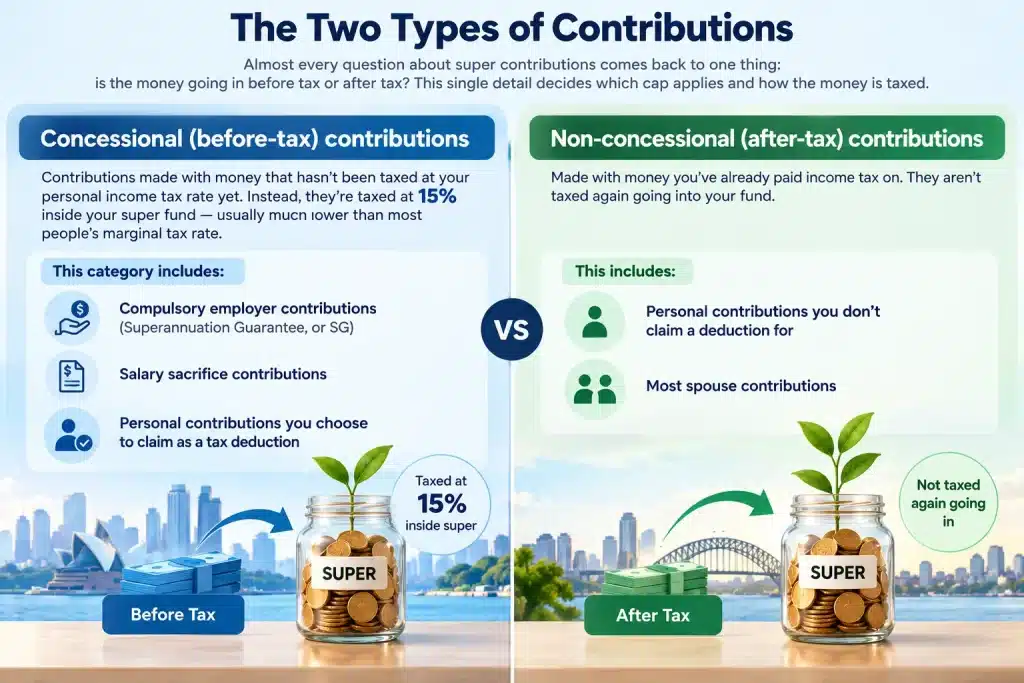
Almost every question about super contributions comes back to one thing: is the money going in before tax or after tax ?

This single detail decides which cap applies and how the money is taxed.

Infographic comparing concessional before-tax and non-concessional after-tax super contributions, including their tax treatment and common contribution types.

Concessional (before-tax) contributions: are contributions made with money that hasn’t been taxed at your personal income tax rate yet.

Instead, they’re taxed at 15% inside your super fund, and it’s usually much lower than most people’s marginal tax rate.

This category includes:

  1. Compulsory employer contributions (Superannuation Guarantee, or SG)
  2. Salary sacrifice contributions
  3. Personal contributions you choose to claim as a tax deduction

Non-concessional (after-tax) contributions:  are made with money you’ve already paid income tax on. They aren’t taxed again going into your fund.

This includes personal contributions you don’t claim a deduction for, and most spouse contributions.

Here’s the simple test: if the money reduces your taxable income (through your employer, a salary sacrifice arrangement, or a claimed deduction),

it’s concessional. If it doesn’t, it’s non-concessional.

How Much Can You Contribute in 2026–27?

Concessional (before-tax) cap: $32,500 a year.
This is a combined total of your Employer contributions, salary sacrifice, and any personal contributions you claim as a deduction, all added together against this one limit and not separately.

Non-concessional (after-tax) cap: $130,000 a year.
This applies to money you contribute without claiming a deduction, including most spouse contributions.

If you go over either cap, the excess is generally taxed at your marginal tax rate, and in some cases extra charges apply.

It’s far cheaper to check your numbers before you contribute than to fix an excess contribution afterwards.

Bring-forward rule for larger after-tax contributions

If you’re under 75 and want to put in more than $130,000 after tax in one year, then, for example, from an inheritance or the sale of an asset that you may be able to “bring forward” up to three years of your non-concessional cap in a single year.

How much depends on your total super balance (TSB) as at the previous 30 June:

  1. TSB under $1.84 million: bring forward up to $390,000 over three years
  2. TSB from $1.84 million to under $1.97 million: bring forward up to $260,000 over two years
  3. TSB from $1.97 million to under $2.1 million: only the standard $130,000 in the current year, no bring-forward
  4. TSB of $2.1 million or more: your non-concessional cap is nil, and you can’t make after-tax contributions at all

Carry-forward rule for unused before-tax cap

If you haven’t used your full concessional cap in previous years, you may be able to carry forward the unused amount and use it later.

But only if your total super balance was under a set threshold at the end of the previous financial year, and only for unused amounts from the past five years.

This is a genuinely useful strategy for people with irregular income, such as a year with a big bonus or a business sale, but eligibility should be checked against your own balance and contribution history before relying on it.

Employer Contributions and the Super Guarantee (SG)

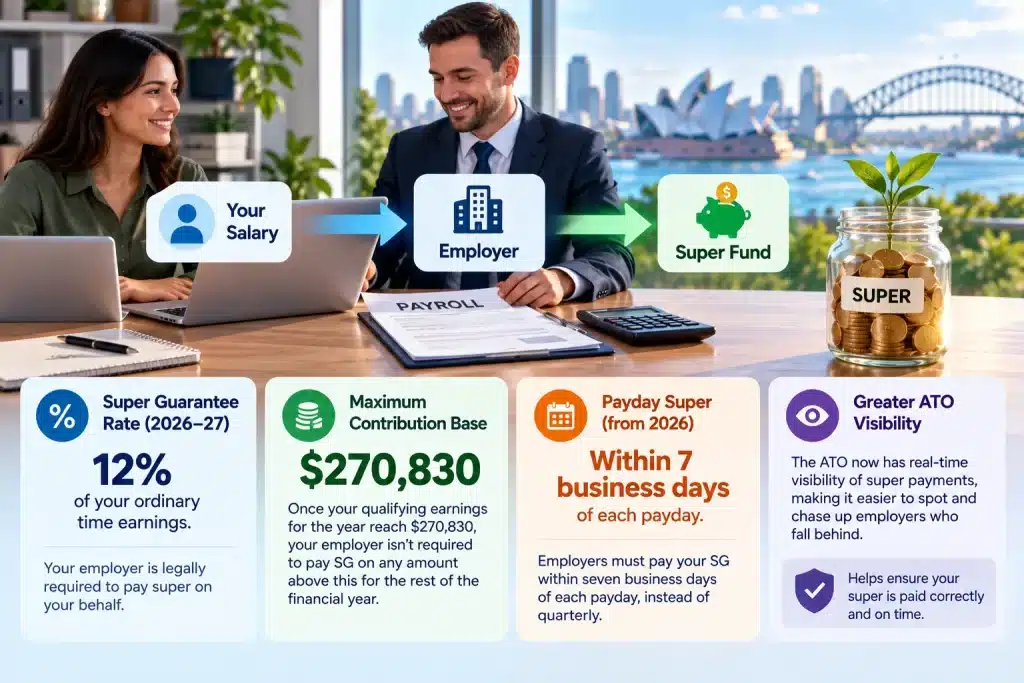
Infographic showing employer superannuation contributions flowing from salary to a super fund, with the 12% Super Guarantee rate, contribution cap, payday super timing, and ATO visibility.

Your employer is legally required to pay super on your behalf. For 2026–27, the Super Guarantee rate is 12% of your ordinary time earnings.

This has climbed steadily since super became compulsory in the 1990s, and 12% is the rate now locked in.

There’s a ceiling, though. Once your qualifying earnings for the year reach the maximum contribution base of $270,830, your employer isn’t required to pay SG on anything you earn above that amount for the rest of the financial year (though some awards or agreements may still require it).

A significant recent change: from 2026, “payday super” requires employers to pay your SG within seven business days of each payday, instead of the old system of quarterly payments.

The ATO now has real-time visibility of late payments, which makes it easier to spot and chase up employers who fall behind.

Salary Sacrifice: Trading Salary for Super

Salary sacrifice is an agreement with your employer where you give up part of your before-tax salary in exchange for extra super contributions.

It sits alongside your employer’s compulsory SG and not instead of it, and both count towards the same $32,500 concessional cap.

The appeal is straightforward: instead of that portion of your salary being taxed at your marginal rate (which could be 30%, 37%, or 45%), it’s taxed at just 15% inside your fund.

For many middle and higher-income earners, that’s a meaningful saving, as long as it doesn’t push their total concessional contributions over the cap.

Making a Personal Contribution

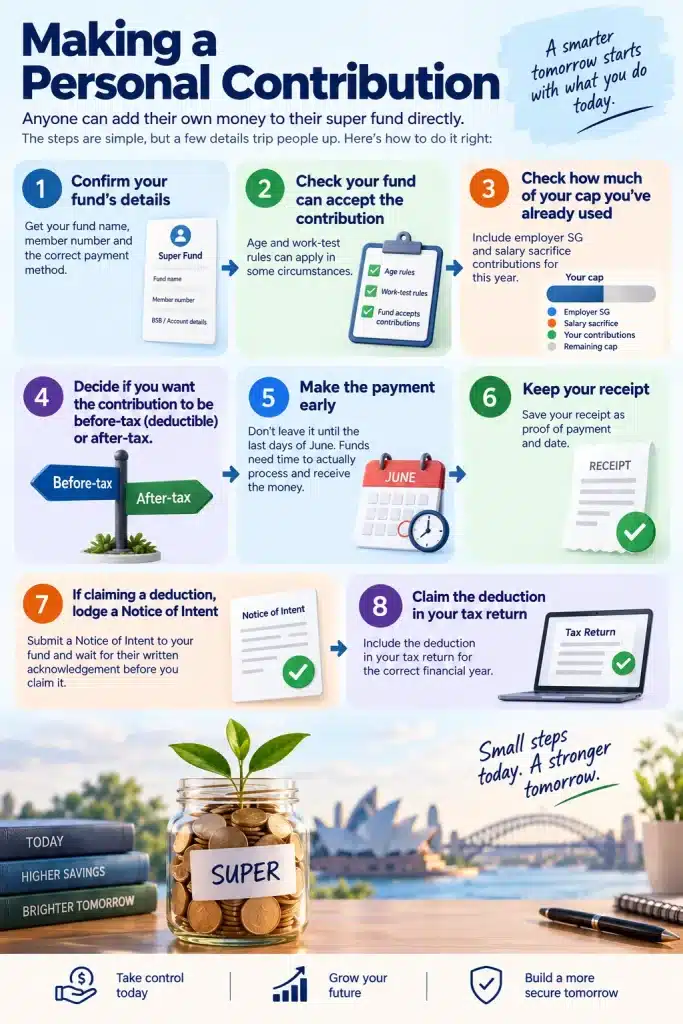
Anyone can add their own money to their super fund directly. The steps are simple, but a few details trip people up:

1. Confirm your fund’s details — fund name, your member number, and the correct payment method.
2. Check your fund can accept the contribution. Age and work-test rules can apply in some circumstances.
3. Check how much of your cap you’ve already used this year, including employer SG and salary sacrifice.
4. Decide if you want the contribution to be before-tax (deductible) or after-tax.
5. Make the payment early—  don’t leave it until the last days of June, because the funds need time to actually process and receive the money.
6. Keep your receipt as proof of payment and date.
7. If claiming a deduction, then lodge a Notice of Intent with your fund and wait for their written acknowledgement before you claim it.
8. Claim the deduction in your tax return for the correct financial year.

The Notice of Intent step people forget

Transferring money into your super fund does not automatically make it tax-deductible.

If you want to claim a deduction for a personal contribution, you must complete a Notice of Intent to Claim a Deduction form and get written acknowledgement from your fund before you lodge your tax return claiming it.

Skip this step, and the contribution is simply treated as non-concessional, and that cause no deduction, but it still counts toward your after-tax cap.

Spouse Contributions

If your spouse earns a low income or isn’t working, you can contribute to their super and receive a tax offset for doing so. For 2026–27:

  1. The maximum offset is $540 a year.
  2. It applies in full if your spouse’s income is $37,000 or less.
  3. The offset gradually reduces as their income rises, cutting out completely once they earn $40,000 or more.
  4. The contribution must be non-concessional (you can’t claim a personal deduction for it), and your spouse’s own total super balance and contribution caps still apply.

For example, if your spouse earns $38,500 (partway through the phase-out range) and you contribute $3,000 to their super, only part of that $3,000 will attract the full offset and the rest still boosts their balance, just without the tax offset attached to every dollar.

Downsizer Contributions

If you’re 55 or older and selling your main home, you may be able to contribute part of the sale proceeds into super as a “downsizer contribution“, and it’s up to $300,000 per person ($600,000 for a couple).

This sits completely outside the normal concessional and non-concessional caps, and there’s no upper age limit or work test.

You generally need to have owned the home for at least 10 years, and the contribution must be made within a set window after settlement.

Government Co-Contribution

If you’re a low- or middle-income earner and make an after-tax contribution to your own super, the government may add to it. For every dollar you contribute, the government adds up to 50 cents, to a maximum of $500 a year, if your income is $64,293 or less for 2026–27.

This is essentially free money for eligible contributors, but you need to lodge a tax return and meet the income and contribution conditions for it to be paid automatically.

Common Mistakes to Avoid

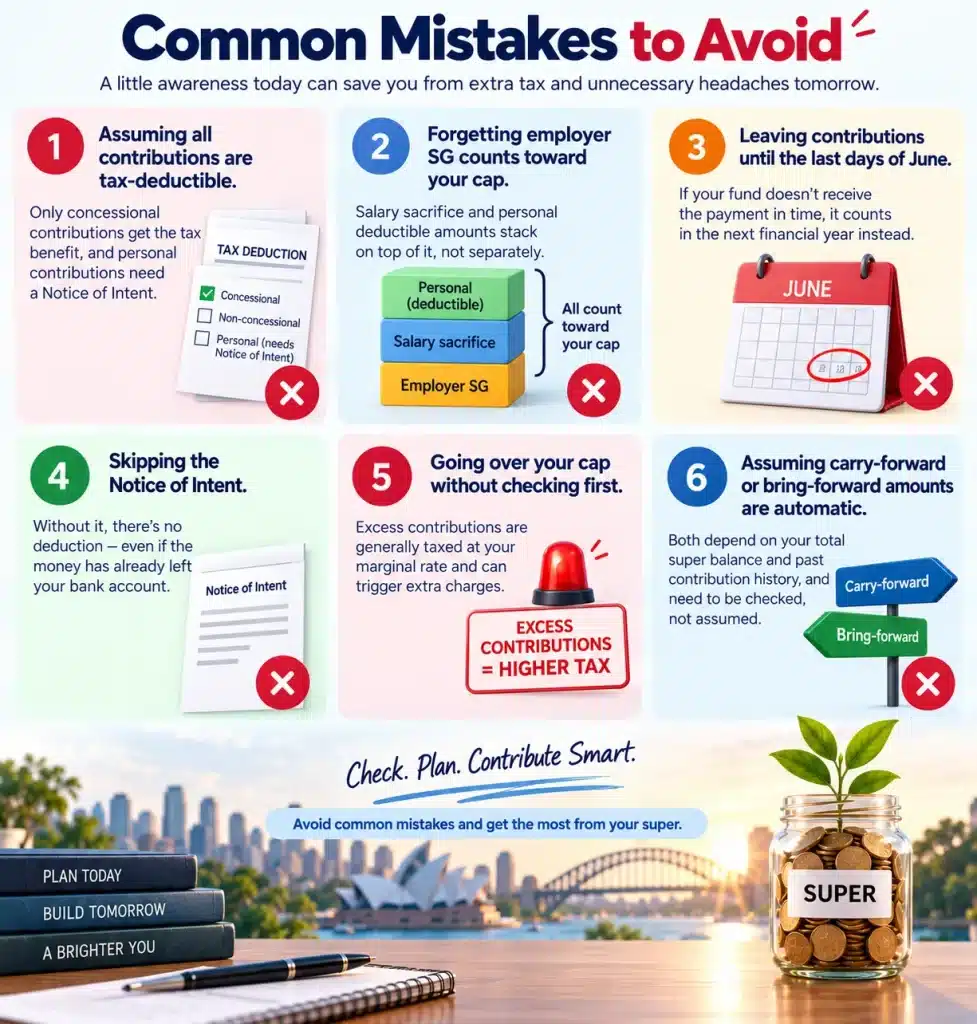
Infographic highlighting six common super contribution mistakes, including missed tax deductions, exceeding contribution caps, late payments, skipping the Notice of Intent, and misunderstanding carry-forward and bring-forward rules.
  1. Assuming all contributions are tax-deductible. Only concessional contributions get the tax benefit, and personal contributions need a Notice of Intent.
  2. Forgetting employer SG counts toward your cap. Salary sacrifice and personal deductible amounts stack on top of it, not separately.
  3. Leaving contributions until the last days of June. If your fund doesn’t receive the payment in time, it counts in the next financial year instead.
  4. Skipping the Notice of Intent. Without it, there’s no deduction, even if the money has already left your bank account.
  5. Going over your cap without checking first. Excess contributions are generally taxed at your marginal rate and can trigger extra charges.
  6. Assuming carry-forward or bring-forward amounts are automatic. Both depend on your total super balance and past contribution history, and need to be checked, not assumed.

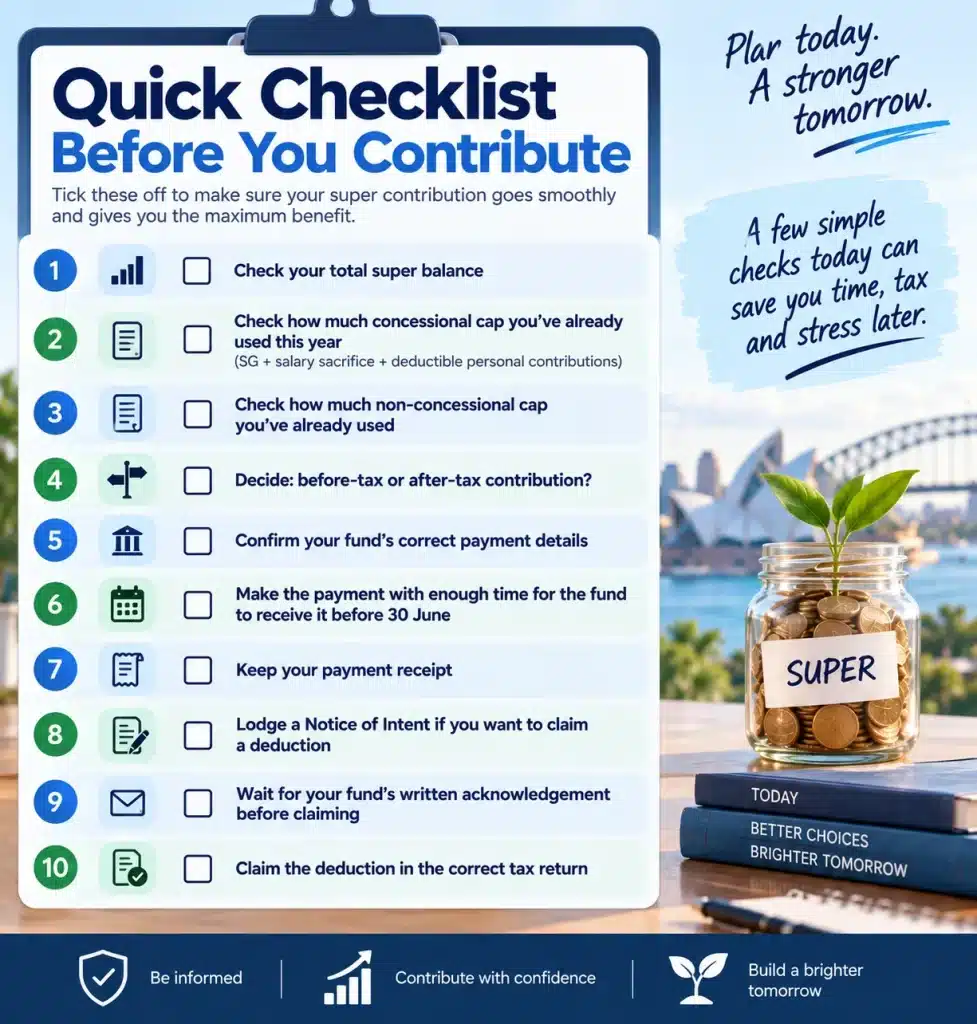
Quick Checklist Before You Contribute

  1. [ ] Check your total super balance
  2. [ ] Check how much concessional cap you’ve already used this year (SG + salary sacrifice + deductible personal contributions)
  3. [ ] Check how much non-concessional cap you’ve already used
  4. [ ] Decide: before-tax or after-tax contribution?
  5. [ ] Confirm your fund’s correct payment details
  6. [ ] Make the payment with enough time for the fund to receive it before 30 June
  7. [ ] Keep your payment receipt
  8. [ ] Lodge a Notice of Intent if you want to claim a deduction
  9. [ ] Wait for your fund’s written acknowledgement before claiming
  10. [ ] Claim the deduction in the correct tax return

Frequently Asked Questions

Concessional contributions are made before tax (or claimed as a deduction) and taxed at 15% in your fund. Non-concessional contributions are made after tax and aren’t taxed again going in.

For 2026–27, up to $32,500 before tax (concessional) and up to $130,000 after tax (non-concessional), unless you’re using bring-forward or carry-forward rules.

No. You need to lodge a Notice of Intent with your fund and receive written acknowledgement before you can claim the deduction in your tax return.

The excess is generally taxed at your marginal tax rate, and additional charges can apply depending on which cap was exceeded. It’s worth checking your position before you contribute, not after.

Generally no, once you’re an eligible employee then  12% is the compulsory Super Guarantee rate for 2026–27, though some awards or enterprise agreements may require more.

It’s a tax offset of up to $540 for contributing to a low-income or non-working spouse’s super, phasing out once their income reaches $40,000.


Talk to AMA Accountants Before You Contribute

Contribution rules look simple on paper, but caps, deadlines, and paperwork like the Notice of Intent are exactly where things go wrong in practice.

If you’re planning a bigger contribution, a downsizer contribution, or you’re not sure which cap you’ve already used, AMA Accountants can check your position and help you get it right before the money leaves your account.

Call: 0420 529 890   |   Website: www.amaaccountant.com.au

Certified Public Accountants  |  Registered Tax Agents  |  Tax Practitioners Board Registered

Serving Adelaide  |  Melbourne  |  Sydney  |  Perth  |  Canberra  |  Darwin  |  Tasmania  |  Australia-Wide

Amit Chugh – Partner, CPA & Registered Tax Agent in Melbourne, Brisbane, Sydney, Tasmania, Perth, Adelaide, Darwin, Canberra, and regional hubs including Prospect, Modbury, Mawson Lakes, Woodville, Mount Gambier, Victor Harbor, Whyalla, Port Lincoln, Murray Bridge, Port Augusta, Gawler, and Port Pirie.

Authored By Amit Chugh

Partner, CPA & Registered Tax Agent
Your Trusted Accountant for Adelaide, Melbourne, Sydney, Brisbane & Across Australia

Amit Chugh is a Partner at The AMA Accountant and a highly respected CPA & Registered Tax Agent with a proven track record of delivering exceptional accounting and taxation services to individuals, businesses, and corporations across Australia.

With over 25+ of professional experience, Amit has helped thousands of clients streamline their finances, optimise tax returns, and ensure full compliance with Australian Taxation Office (ATO) requirements. His client base spans Melbourne, Brisbane, Sydney, Tasmania, Perth, Adelaide, Darwin, Canberra, and regional hubs including Prospect, Modbury, Mawson Lakes, Woodville, Mount Gambier, Victor Harbor, Whyalla, Port Lincoln, Murray Bridge, Port Augusta, Gawler, and Port Pirie.

Disclaimer

This content is for general informational purposes only and does not constitute financial, tax, legal, or business advice. Outcomes may vary based on individual circumstances, applicable laws, and current regulations, which may change over time.

We recommend seeking personalised advice from a qualified professional before making any decisions. AMA Accountants is a registered provider of accounting and tax services in Australia.

Posted in
Blog & News
At AMA Accountants, we’re here to make accounting simple and stress-free. As one of Australia’s trusted accounting firms, our goal is to provide financial services that help you grow—whether it’s for your business or your personal finances. Our friendly team takes the time to understand your situation, so we can give you advice that actually works for you. From tax and bookkeeping to business planning and financial advice, we cover everything you need under one roof. With years of experience and a focus on practical solutions, we’re here to save you time, reduce stress, and help you reach your goals faster.

Book a Meeting Room with AMA Accountants

Fill out the form and Speak With Our Team.

=

🔒 Your information is 100% secure & confidential

Book a Meeting Room with AMA Accountants

Fill out the form and Speak With Our Team.

=

🔒 Your information is 100% secure & confidential

Get Your Tax Return Done — Fast & Stress-Free

Fill out the form and our registered tax experts will handle everything for you.

💰 Average refund: $2,500+

✔ Maximise your refund   |
✔ ATO-compliant   |
✔ Quick turnaround

=

🔒 Your information is 100% secure & confidential