











What Can I Claim on Tax in Australia? The Simple, Trustworthy Guide (2026-2027)
Table of Contents
ToggleI Know You worked hard for your money, and Tax time is your chance to claim back some of what you spent to earn it. Right?
But the rules are strict, and getting them wrong can cost you either in missed money or in a letter from the ATO asking you to explain yourself.
When this happened to you, I feel very sad for you.
That’s the reason I wrote this guide, and the better part is that each fact, tip, and piece of info is in very easy English and very simple language so you don’t get confused.
Every number in it comes from the Australian Taxation Office (ATO) website.
The bottom of the guide has the resources link so you can cross-check if you want to check and verify.
You can claim money back on something if three things are true:
- you paid for it yourself,
- it helped you earn your income,
- and you can show proof.
For example: Common claims include working-from-home costs, work car trips, tools, courses tied to your job, memberships, income protection insurance, and gifts to charity.
Now, maybe you get the idea of what we can claim. Now let’s move to what we can’t claim
You cannot claim your normal drive to work, plain clothes ( instead of a work-related uniform), or anything your boss already paid you back for.
Current Rates at a Glance (Checked September 2026)
The tax rates change every year, and here are the numbers that matter most right now, with the year each one applies to:
| What | Rate | Which Year |
|---|---|---|
| Car expenses (cents per km method) | 88 cents per km | 2025–26 (the return most people are lodging now) |
| Car expenses (cents per km method) | 91 cents per km | 2026–27 (the current financial year) |
| Car method cap | 5,000 km per car per year | Both years |
| Working from home (fixed rate) | 70 cents per hour | 2025–26 |
| No-receipts limit (total work expenses) | $300 | Ongoing |
| Laundry claim without a receipt | Up to $150 | Ongoing |
| New "standard deduction" for work expenses | Up to $1,000, no receipts needed | Starts 2026–27 (confirm current legal status before relying on it) |
Because these numbers move every year, as per the rules.
So please check them before you lodge, especially the newest one.

The Three Rules Every Deduction Must Follow otherwise You have the chances to get the penelaty from ATO
Always keep in mind: Before you look at any list, learn these three rules, because they decide almost everything.
Rule 1: You paid for it, and nobody paid you back.
For example: If your boss paid for it or gave you the money back, it’s not your deduction. It’s theirs.
Rule 2: It’s connected to your income.
The money must have helped you earn your pay.
For example: A gym membership might make you feel better at work. That’s not enough reason. There must be a direct link to your income.
Rule 3: It’s not a private cost, and you can prove it.
Everyday things like groceries, your normal clothes, and your regular drive to work are private costs.
They don’t count, even if work benefits from them a little. And you need some kind of proof, like a receipt, a bill, or a clear record.
In my simple words: If you can’t explain the work connection in one simple sentence, it’s probably not safe to claim.
The Master List: What You Can Usually Claim
| What You Spent Money On | Can You Claim It? | The Main Condition |
|---|---|---|
| Driving for work (not your normal commute) | Yes | Use the cents-per-km method or a logbook |
| Working from home | Yes | You need a record of your actual hours |
| Uniforms, protective clothing | Yes | Must be a real uniform or safety gear, not plain clothes |
| Tools and equipment under $300 | Yes, in full, straight away | Must be for work use |
| Tools and equipment over $300 | Yes, spread over a few years | This is called depreciation |
| Courses related to your current job | Yes | Not for a brand-new career |
| Union fees and work memberships | Yes | Must relate to your job |
| Income protection insurance (bought yourself, not through super) | Yes | Life insurance and TPD insurance don't count |
| Gifts to registered charities | Yes | $2 or more, no gift back to you |
| Interest on a loan for shares or a rental property | Yes | Must be for something that earns you income |
| Rental property costs | Yes | Repairs count now; improvements are spread over time |
| Tax agent fees | Yes | Claimed in the year you paid them |

Car Expenses: The Deduction People Get Wrong Most Often and may be you too.
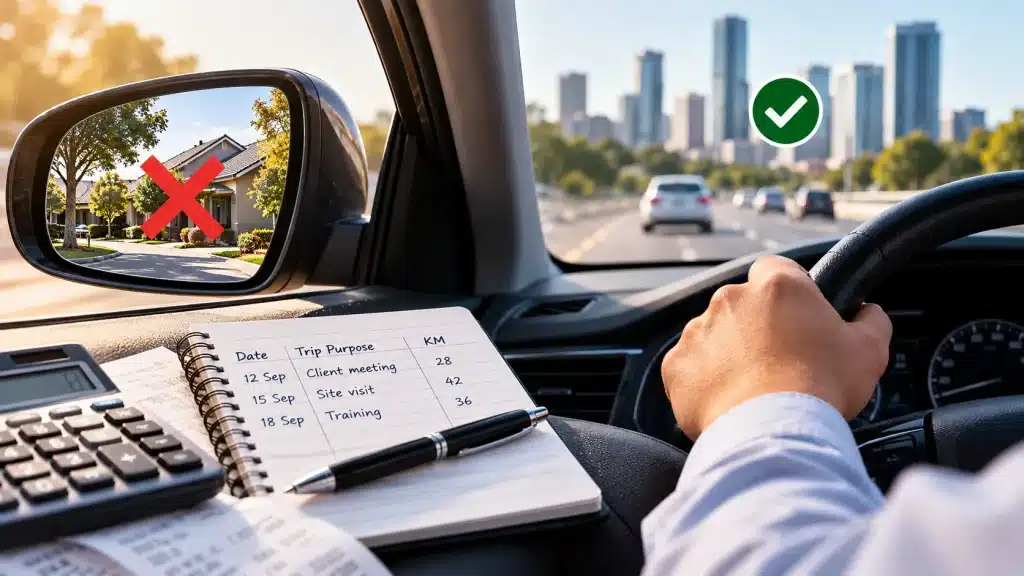
Your everyday drive to your normal job doesn’t count as a deduction, even if you carry tools or if there’s no bus either.
This is one of the ATO’s strictest rules, and it catches more people than almost anything else.
Now you’re thinking, Amit, then What Acutally does count?
1. Driving between two different job sites,
2. Driving to see a client,
3. Driving from your regular workplace to a training day somewhere else.
Method 1 — Cents per kilometre.
You count your work kilometres and multiply by the rate.
For the 2025–26 year (the one most people are lodging right now), the rate is 88 cents per kilometre.
From 1 July 2026, the rate for the 2026–27 year rises to 91 cents.
Either way, you can only count up to 5,000 km per car, per year.
You don’t need fuel receipts for this method, but you do need to be able to explain how you worked out your kilometres.
A diary of your regular work trips is enough to explain.
Method 2 — Logbook.
In this method, you have to keep a logbook for 12 weeks in a row.
Write down every trip: the date, why you went, and the start and end reading on your odometer.
That 12-week logbook then tells you what percentage of your car use is for work, and you apply that percentage to all your real car costs such as fuel, rego, insurance, and more.
A logbook stays valid for five years if your driving pattern doesn’t change much.
If you drive a lot for work, this method often gives you a bigger claim than the per-kilometre method, because there’s no 5,000 km cap.
So, travellers, you just need to pack your bags and travel the whole world… ha, I’m just kidding.

Working From Home ( Yes I'm talking about your benefits): We have two ways to claim Deduction.
Method 1 — Fixed rate.
For the 2025–26 year, the rate is 70 cents for every hour you work from home.
This one rate already covers your electricity, gas, phone, internet, and everyday office supplies like printer paper.
You can’t also claim those things separately if you use this method; that would be claiming the same cost twice.
And if you claim, you will receive the 5-page-long letter from the ATO that might disturb your sleep.
You must have a real record of your hours.
Since March 2023, the ATO no longer accepts a guess or a rough four-week sample.
You need something like a timesheet, roster, or diary covering the actual hours you worked from home across the whole year.
If you didn’t start keeping a record on day one, start today; you can still claim for the period you do have proof of work.
You can still separately claim the cost of big items like a laptop, monitor, or office chair, spread out over their useful life, because the fixed rate doesn’t cover those.
Method 2 — Actual cost.
Work out the real, work-related share of every single running cost yourself, such as electricity, internet, phone, and more.
This takes more paperwork, but if your home office costs are high, it can add up to a bigger claim.
So, the highly paid consultants who live in Australia and work from home, like internet marketers, Gurus, Coaches, healers, ecommerce experts, consultants, and young content creators.
You need to connect with us will help you in this.

Clothing and Laundry ( Yes you can claim but you couldnt able to claim for your pajamas.)
Plain clothes are never deductible, even if you only wear them to work.
A black shirt or a suit is still just clothing.
Now you’ve got the idea you should wear the uniform.
What you can claim:
- Occupation-specific clothing — clothes that look like your job, and nobody would wear on the weekend. Think of a chef’s checked pants.
- Protective clothing — steel-capped boots, hi-vis vests, safety glasses, and similar safety gear.
- A compulsory uniform — one your employer makes you wear, and that follows the official rules for a registered uniform.
For laundry, you can claim $1 per load if it’s only work clothes, or 50 cents per load if it’s mixed with other washing.
You don’t need a receipt for laundry claims under $150. You just need a reasonable way of showing how you worked it out.

Tools, Equipment, and Technology (I love it because i'm also tech nerd)
If an item costs $300 or less, and you use it for work, you can claim the full cost straight away, in the same year you bought it.
If it costs more than $300, you spread the cost over the item’s useful life.
This is called depreciation. If you use something for both work and home, you can only claim the work-related share.

Self-Education (Enroll the course which can help you grow more in your career)
A course only counts if it’s connected to the job you have right now.
Not a Scammy Crypto trading course.
A nurse doing an extra nursing course: that’s deductible.
The same nurse studying to become a dentist: that’s a new career, so it’s not deductible, even though it’s still education.
So you have to be very clear.
One older rule to know: there used to be a $250 amount that got taken off your self-education claim automatically.
That rule was removed from 1 July 2022. So today, an eligible self-education expense is deductible from the very first dollar.

Professional Memberships and Union Fees
Yearly fees for a union, or a professional body linked to your job, are fully deductible.
Your work-related magazine or journal subscriptions are also deductible.
But a general news subscription doesn’t count, even if you sometimes read something work-related in it.

Income Protection Insurance
Do you personally pay for income protection insurance?
This is the kind of insurance that replaces part of your pay if you get sick or hurt and can’t work; those payments are deductible in your Personal (Individual) Tax Return.
This is one of the most missed deductions in Australia.
But be careful: life insurance, trauma insurance, and total-and-permanent-disability (TPD) insurance are not deductible.
And if your income protection is paid for from inside your superannuation.
Then you can’t claim it on your personal return either, because the premium never came out of your own after-tax pocket.

Investment and Rental Property (Invested to get consistent income)
If you own shares or a rental property?
Then the good news is that you are eligible to claim some of your costs.
To get a better understanding, here is an example: a rental property that includes loan interest, council rates, water charges, land tax, property management fees, insurance, and repairs.
The most important rule here: a repair fixes something back to how it was; that’s an immediate deduction.
An improvement makes something better than it was before; that has to be spread out over time instead.
Mixing these two up is the single biggest mistake we see in rental property tax returns.

Charitable Donations (You Should make the donation)
A gift of $2 or more to a registered charity (called a Deductible Gift Recipient, or DGR).
The DGR is deductible in your tax return.
You can check whether a charity is registered using the ABN Lookup tool.
So you can ensure your donation is legitimate.
If you got something back for your donation, like a raffle ticket or a dinner.
It generally doesn’t count as a pure gift, so it may not be deductible.

Tax Agent Fees ( Yeah you read it right.. it's also deductible in tax return)
The fee you pay someone like AMA Accountants to prepare and lodge your tax return is itself deductible in the year you actually pay it.
That includes preparation fees, advice fees, and even the cost of travelling to see your accountant.
So why do you want to go with someone else?
Here’s a detail people often miss:
If you paid last year’s tax agent fee this year, you claim it this year, not last year.
That prior-year fee is one of the most commonly forgotten deductions in Australia.
Now, here’s the chance: click the button below and book an appointment with us to sort out your tax return.
What Can You Claim in your Tax return Without a Receipt in Australia?
You can claim up to $300 in total work-related expenses without a receipt for every single item.
But you must have actually spent the money, and you need a sensible way to explain how you worked out the amount.
So the thing is you have to keep the records of your expenses, and when you go to lodge your tax return, then you have to explain it.
This $300 limit is for your whole claim added together, not $300 for each thing you bought.
The moment your total work-related claims go over $300, you need proper written evidence for everything, including the smaller items that would have been fine on their own.
A few claims have their own separate no-receipt rules:
| Claim | No-Receipt Limit | What You Still Need |
|---|---|---|
| General work expenses | $300 total | A sensible way to show how you calculated it |
| Car (cents per km) | Up to 5,000 km | A record showing how you worked out your kilometres |
| Laundry | Up to $150 | A reasonable basis, like loads per week |
| Small charity bucket donations | Under $10 each | Nothing extra needed |
Keep your evidence as you go, not months later. The ATO can ask you to prove a claim years after you lodge your return.
If you can’t show proof, the deduction can be taken away, and you may owe extra tax and interest.
What You Cannot Claim: The Common Mistakes
| You Can't Claim This | Why |
|---|---|
| Driving to your normal job | This is private travel, even with no public transport nearby. |
| Plain clothes worn to work | Not a uniform, so it's ordinary clothing. |
| Things that just help you feel good, like a gym membership | Too general, with no direct income link. |
| Life, trauma, or TPD insurance | Only income protection (bought outside super) counts. |
| Money given to a non-registered charity, or a crowdfunding page | Only registered DGR charities qualify. |
| A course for a completely new career | Must relate to your current job. |
| Meals at your normal workplace | Food is a private cost unless you're travelling away overnight for work. |
| The cost of finding your first job | This happens before you're earning income, so it doesn't count. |

The New $1,000 Standard Deduction (Latest News)
The government has been working on a new rule:
A flat $1,000 deduction for work expenses, with absolutely no receipts required.
Starting from the 2026–27 income year (1 July 2026 onward). It does not apply to the 2025–26 return most people are lodging right now.
Here’s how it’s designed to work:
If your genuine work expenses are less than $1,000, you’d simply get the full $1,000 anyway.
But if your real expenses are more than $1,000, you claim your actual, higher amount instead, the normal way.
It’s meant to be applied automatically for eligible workers, so most people won’t need to do anything extra to get it.
A few things it won’t replace:
Union fees and professional memberships are claimed separately, on top of the $1,000.
This is a new and still-developing rule at the time of writing, so please confirm its exact legal status on the ATO page linked below before relying on it.

A Simple Worked Example For Your Overview
Meet Sam. Sam earns $85,000 a year working in an office.
- Working from home: Sam kept a proper hours record and claims $500 under the fixed rate method.
- Phone: Sam works out the work-related share of the phone bill: $150.
- A work membership: $200.
- A work laptop bag: $150, claimed in full because it’s under $300.
Add these up: $500 + $150 + $200 + $150 = $1,000 in deductions.
Here’s the part people get wrong:
A $1,000 deduction does not mean Sam gets $1,000 back as a refund. A deduction lowers your taxable income, not your tax bill directly.
Sam’s taxable income drops from $85,000 to $84,000. The actual dollar saving depends on Sam’s tax bracket .
Usually somewhere between 16 and 45 cents back for every dollar deducted, not a full dollar-for-dollar refund.
Your Deduction Checklist You have to Keep This in your Mind
Car expenses for work travel (not your normal commute)
Working-from-home hours, properly recorded
Phone and internet, work-related share only
Tools and equipment
Eligible protective or uniform clothing, plus laundry
Professional memberships and union fees
Self-education tied to your current job
Income protection insurance (bought outside super)
Charity donations to registered DGRs
Rental property or investment expenses, if you have them
Last year’s tax agent fee
All receipts, diaries, and logbooks kept safely
Frequently Asked Questions
No. Ordinary travel between your home and your regular workplace is private travel, and it’s never deductible.
Not even if you carry tools, work irregular hours, or have no public transport option.
Up to $300 in total work-related expenses, as long as you genuinely spent the money and can explain how you worked out the amount.
Car claims under the cents-per-km method and laundry under $150 have their own separate no-receipt allowances.
Only if you’re lodging for the 2026–27 income year or later.
It does not apply to the 2025–26 return most people are lodging right now.
70 cents per hour for the 2025–26 income year, covering electricity, gas, phone, internet, and everyday office supplies.
You need a genuine record of your actual hours.
No. A deduction reduces your taxable income, not your tax bill directly.
Your actual savings depend on your tax bracket.
Confusing a repair (immediately deductible) with an improvement (which has to be spread out over several years).
This single mix-up causes more incorrect rental returns than anything else.

Get It Checked by a Registered Tax Agent and Tax Accountants
Rules change every year, and a missed deduction is money you never get back.
AMA Accountants’ CPA-certified, ATO-registered tax agents review every category above against your real situation.
We don’t use a generic checklist, so you claim everything you’re entitled to and nothing you’re not.
Click the Button below to book an appointment with our tax experts.
Resources and References :
Every rate and rule above comes from one of these sources.
Please check them directly before lodging, since tax rules and rates are reviewed and can change every income year:
- Australian Taxation Office — Deductions you can claim: general overview of work-related and other deductions
- Australian Taxation Office — Cents per kilometre deduction rate for car expenses: current and prior-year rates
- Australian Taxation Office — Fixed rate method (working from home): current rate and record-keeping requirements
- Australian Taxation Office — Self-education expenses: eligibility rules
- Australian Taxation Office — Standard deduction for work-related expenses: status, eligibility, and start date of the $1,000 measure
- Australian Taxation Office — Rental properties: repairs versus capital improvements, and other rental deductions
- ABN Lookup — for checking whether a charity is a registered Deductible Gift Recipient (DGR)

Authored By Amit Chugh
Partner, CPA & Registered Tax Agent
Your Trusted Accountant for Adelaide, Melbourne, Sydney, Brisbane & Across Australia

Amit Chugh is a Partner at The AMA Accountant and a highly respected CPA & Registered Tax Agent with a proven track record of delivering exceptional accounting and taxation services to individuals, businesses, and corporations across Australia.
With over 25+ of professional experience, Amit has helped thousands of clients streamline their finances, optimise tax returns, and ensure full compliance with Australian Taxation Office (ATO) requirements. His client base spans Melbourne, Brisbane, Sydney, Tasmania, Perth, Adelaide, Darwin, Canberra, and regional hubs including Prospect, Modbury, Mawson Lakes, Woodville, Mount Gambier, Victor Harbor, Whyalla, Port Lincoln, Murray Bridge, Port Augusta, Gawler, and Port Pirie.
Disclaimer
This content is for general informational purposes only and does not constitute financial, tax, legal, or business advice. Outcomes may vary based on individual circumstances, applicable laws, and current regulations, which may change over time.
We recommend seeking personalised advice from a qualified professional before making any decisions. AMA Accountants is a registered provider of accounting and tax services in Australia.