Your Simple Guide to Australian Tax Returns for 2025 & 2026
Table of Contents
ToggleTax time doesn’t have to be stressful. Whether you’re an employee with a simple income statement, an investor, or you run a small business, this simple guide walks you through how to complete your tax return in Australia and claim what you’re entitled to. We’ll help you lodge correctly with the Australian Taxation Office (ATO) and aim for you to get every dollar you deserve.
What Is a Tax Return in Australia?
A tax return is the form you lodge each year with the ATO. It shows how much money you earned, what deductions you’re claiming, and how much tax you’ve already paid. The income year runs from 1 July to 30 June.
If you’ve had tax withheld from your pay (PAYG), you still must lodge a return — the return tells the ATO whether you owe more, or if you’re due a refund.
Who Needs to Lodge a Tax Return?
Generally, you must lodge a return if you are a resident for tax purposes and any of the following apply:
- You earned income (employment, business, or investments) during the year.
- Your employer withheld tax from your pay (shown on your income statement).
- You want to claim work-related deductions or tax offsets to get a refund.
- You earned above the tax-free threshold (currently about $18,200).
- You ran a business, even as a sole trader.
Key Dates and Deadlines
Missing a deadline can lead to penalties. Know the timeline for a smooth tax season.
- Financial year ends: 30 June 2025 (for the 2024-25 year).
- Lodgement opens for individuals via myTax from: 1 July 2025.
- If you lodge yourself (not using a tax agent), the usual due date is 31 October 2025.
- If you use a registered tax agent and were their client by 31 October, you may get an extended due date (often up to 15 May next year) for your agent-lodged return.
Lodging early can help you avoid stress, allow time to get your documents in order, and avoid last-minute errors
How to Lodge a Tax Return?
Here’s a simple step-by-step process:
- Gather your documents: income statements, bank interest, dividend statements, receipts for deductions.
- Log into myGov, link to the ATO, and access myTax if lodging yourself.
- Check pre-fill data: Much of your income info will be pre-filled by the ATO from employers/banks — waiting until late July can help get more accurate pre-fill.
- Add deductions: Work-related expenses, home office costs, and other eligible expenses.
- Declare all income: Review the pre-filled income data and add any extra income (side hustle, investments).
- Review and submit: Double check your bank account, BSB, and all numbers.
Receive your assessment: The ATO will send you a Notice of Assessment telling you your refund or tax payable amount.
What Documents You Need
Being organised will make your tax return faster and more accurate.
You’ll typically need:
- Income statements from your employer (linked to ATO).
- Bank and investment interest/dividend statements.
- Rental property income and expense records (if you own rental property).
- Business income (if you have ABN).
- Private health insurance statement (for Medicare Levy Surcharge).
- Donation receipts (for gifts to registered charities).
- Work-related receipts (uniforms, tools, home office).
- Motor vehicle logbook or relevant car expense records.
- Spouse’s income details (if applicable).
Common Deductions You Can Claim
If you spent your own money to help you earn your income and have proof, you may be able to claim it. Here are common deductions:
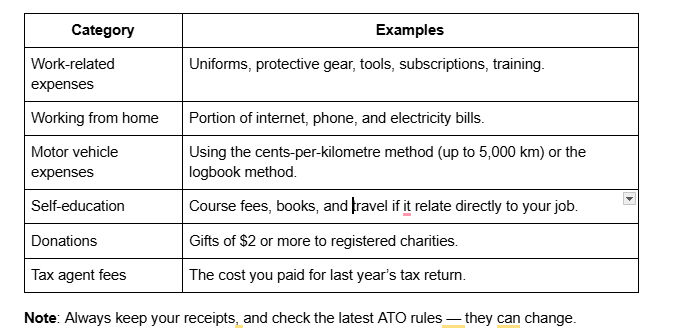
Worked Example – Typical Employee Tax Return
Scenario:
Jasmine is a nurse in NSW. She earned gross income of $85,000 in the 2024-25 year. Her employer withheld $20,000 in PAYG tax. She has these deductions:
- Uniform/laundry: $350
- Work-related portion of mobile phone: $200
- Donations to charity: $150
Total deductions: $700
Calculation:
Taxable income = $85,000 – $700 = $84,300
Approx tax on $84,300 = $19,400 (for example)
Withheld tax = $20,000
Refund ≈ $600
Even small deductions can change your result.
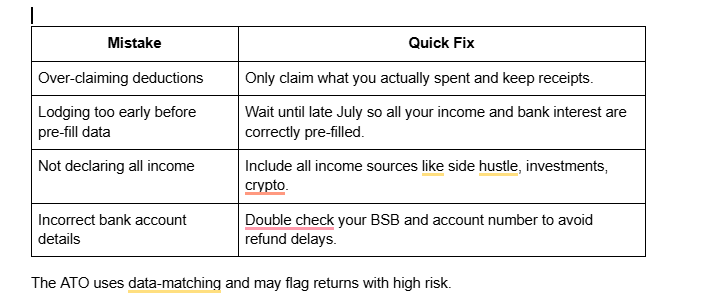
Mistakes That Trigger ATO Reviews & How to Avoid Them
Small Business & Sole Trader Tax Returns
If you’re self-employed, you don’t lodge a separate business tax return — you include your business income and expenses in your individual tax return (via the Business and Professional Items schedule).
Key tips for sole traders:
- Report GST correctly if registered.
- Keep digital records for at least five years.
- Only claim expenses that are directly related to your business.
- Use accounting software (like Xero or MYOB) to make this easier.
Your net business profit is added to your other income and taxed at your personal rate.
FAQs
When can I lodge my tax return for 2025?
You can start lodging your individual tax return for the 2024-25 year from 1 July 2025 via myTax or through a registered tax agent.
How do I get a faster tax refund?
Lodge online, wait for your pre-fill data, declare all income, check your bank details — most refunds arrive within about 2 weeks if no issues.
Can I still lodge late?
Yes. It’s better to lodge late than not at all. Late lodgement may come with penalties. If you use a tax agent, contact them asap.
What if I made a mistake on my return?
You can amend your tax return generally within two years of the date of assessment. Ask your accountant or use myTax.
Do I need receipts for everything?
Yes. The ATO requires you to keep records (receipts, invoices, statements) for at least five years.
Conclusion – Ready to Secure Your Business Future?
Doing your tax return doesn’t have to be hard. With the right support and organised records, you can lodge on time, maximise your refund, and avoid stress. At AMA Accountants, we’re here to help you every step of the way — whether you’re an employee, investor, or small business owner.
Need help? Contact AMA Accountants today and let us guide you through a smooth, compliant tax lodgement.

Authored By Amit Chugh
Partner, CPA & Registered Tax Agent
Your Trusted Accountant for Adelaide, Melbourne, Sydney, Brisbane & Across Australia
Amit Chugh is a Partner at The AMA Accountant and a highly respected CPA & Registered Tax Agent with a proven track record of delivering exceptional accounting and taxation services to individuals, businesses, and corporations across Australia.
Amit Chugh is a Partner at The AMA Accountant and a highly respected CPA & Registered Tax Agent with a proven track record of delivering exceptional accounting and taxation services to individuals, businesses, and corporations across Australia.
With over 25+ of professional experience, Amit has helped thousands of clients streamline their finances, optimise tax returns, and ensure full compliance with Australian Taxation Office (ATO) requirements. His client base spans Melbourne, Brisbane, Sydney, Tasmania, Perth, Adelaide, Darwin, Canberra, and regional hubs including Prospect, Modbury, Mawson Lakes, Woodville, Mount Gambier, Victor Harbor, Whyalla, Port Lincoln, Murray Bridge, Port Augusta, Gawler, and Port Pirie.