
Business Name Registration vs Company Registration: What’s the Difference?
Table of Contents
ToggleIf you are starting a business in Australia, one of the first things you must decide is if you need a business name registration or a company registration. Many new business owners get confused because the terms sound alike, but they are very different under the law.
Choosing the wrong option can affect your taxes, legal protection, and even your personal assets.
In this simple guide, you will learn the clear difference between a business name and a company, based on real rules from ASIC (Australian Securities and Investments Commission) and the ATO (Australian Taxation Office).
This guide is for business owners in Adelaide, Melbourne, Sydney, Perth, Brisbane, Canberra, Darwin, and Tasmania.
1. What Is a Business Name Registration?
A business name is simply the name you use for trading.
Example: If your name is John Smith and your ABN is in your own name, but you want to trade as Smith Landscaping, you need to register Smith Landscaping as your business name.
Key facts about business names (ASIC rule):
– A business name does not create a legal entity.
– A business name does not protect your personal assets.
– A business name must be linked to an ABN.
– A business name does not limit your personal liability.
– Anyone can sue you personally if something goes wrong.
ASIC is clear that registering a business name does not give you exclusive ownership or legal protection unless you also register a trademark.
Who uses business names?
– Sole traders
– Partnerships
– Small freelancers
– Online sellers
– Home businesses
If you operate under your personal legal name, you may not need a business name at all.
2. What Is a Company Registration?
A company is a separate legal entity. This means it exists independently and is responsible for its own debts and obligations. A company gets an ACN (Australian Company Number) from ASIC.
Here are some key facts about companies (ASIC + ATO rules):
– A company protects your personal assets in most cases.
– A company can sign contracts in its own name.
– A company pays tax at the company tax rate, not your personal rate.
– A company must follow ASIC’s reporting rules.
– A company can continue even if the owner changes.
Many businesses choose to be companies because they offer limited liability. This means personal assets like your house or car are usually protected if the business faces financial trouble. According to ASIC, over 2.6 million companies are registered in Australia as of 2024, and this number increases each year as more people prefer the legal protection a company provides.
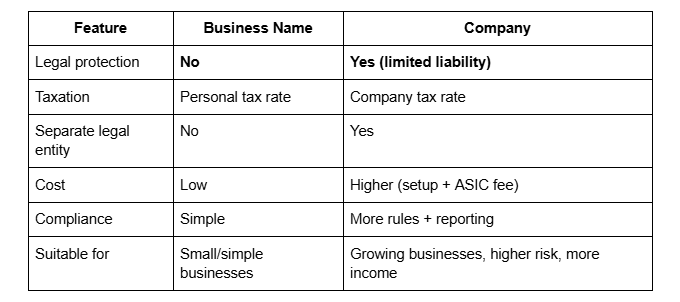
3. Business Name vs Company: The Simple Comparison
4. The Biggest Mistake New Owners Make
Many new business owners often think, “If I register a business name, I legally own the business.” Unfortunately, that’s not quite right.
The name you choose for your business is just that—a name for marketing purposes. It doesn’t define your ownership structure. If things take a turn for the worse, like a client suing you or a contract dispute arising, or if you find yourself in debt, you are personally liable for it all.
That’s why many entrepreneurs decide to shift from being sole proprietors to Pty Ltd companies as their revenue grows. In fact, according to ATO small business data, over 36% of small businesses in Australia operate as companies, as this structure provides better protection and more opportunities for tax planning.
5. When Should You Choose a Business Name Only?
If you are just starting out and making a little cash, a business name is sufficient.
You want something straightforward.
Low setup and low compliance are what you want.
Your company is not at high risk.
You work as a contractor or freelancer.
For instance, Uber drivers, photographers, hair stylists, tutors, and cleaners.
6. When Should You Register a Company?
You should think about a company if:
- You want to protect your personal assets.
- Your income is growing.
- You want to work with bigger clients.
- You want to look more professional.
- You want better tax planning.
- You have business partners.
- You want to bring in investors later.
Many companies also register a business name, but the company stays the legal entity.
7. Can You Have Both?
Yes.
Example:
You register a company called Green Pty Ltd but you want to trade as Green Cleaning Services.
The company owns the business name, and you get:
- Legal protection
- Professional imagE
- Branding flexibility
8. Which One Is Best for Your Situation?
Choosing between a business name and a company depends on the following factors:
– risk level
– income level
– future plans
– whether you have partners
– whether you want legal protection
Most small business owners start with an ABN. However, as income increases or the business faces more risk, switching to a company is safer and more sensible.
Final Advice
AMA Accountants helps business owners in Adelaide, Melbourne, Sydney, Perth, Brisbane, Canberra, Darwin, and Tasmania select the right structure for their tax and legal situation.
📞 +61 (0)420 529 890
📧 finance@amaaccountant.com.au
Authored By Amit Chugh
Partner, CPA & Registered Tax Agent
Your Trusted Accountant for Adelaide, Melbourne, Sydney, Brisbane & Across Australia

Amit Chugh is a Partner at The AMA Accountant and a highly respected CPA & Registered Tax Agent with a proven track record of delivering exceptional accounting and taxation services to individuals, businesses, and corporations across Australia.


With over 25+ of professional experience, Amit has helped thousands of clients streamline their finances, optimise tax returns, and ensure full compliance with Australian Taxation Office (ATO) requirements. His client base spans Melbourne, Brisbane, Sydney, Tasmania, Perth, Adelaide, Darwin, Canberra, and regional hubs including Prospect, Modbury, Mawson Lakes, Woodville, Mount Gambier, Victor Harbor, Whyalla, Port Lincoln, Murray Bridge, Port Augusta, Gawler, and Port Pirie.